
Natural sulforaphane
What is sulforaphane?
A natural molecule that forms in broccoli and other cruciferous vegetables, studied for its ability to activate cellular response mechanisms.
What you need to know
- Sulforaphane is a natural isothiocyanate of plant origin.
- Its main precursor is glucoraphanin, found in broccoli and other cruciferous vegetables.
- Young broccoli sprouts stand out for their high concentration of glucoraphanin.
- Sulforaphane is formed when glucoraphanin comes into contact with the enzyme myrosinase.
- In plants, it is part of a natural defense system. In our bodies, it can also activate cellular response and protection mechanisms.
- It acts on the Nrf2 pathway, involved in the response to oxidative stress, detoxification mechanisms, and the regulation of inflammation.
- The conversion of glucoraphanin into sulforaphane can vary considerably depending on the activity of myrosinase and the gut microbiota.
> 30 years of scientific research
- 1992 — Sulforaphane identified in broccoli by researchers at Johns Hopkins University (United States).
- 1997 — Discovery of the high potential of young broccoli sprouts as a source of glucoraphanin.
- More than 2,800 scientific studies on sulforaphane and its mechanisms of action.
- Human research — Clinical trials exploring its effects on different bodily functions.
- Seven major areas of research: protection against environmental pollution, concentration and cognitive function, glucose regulation, skin health, digestive health, immune response, and healthy aging.

How it works
Your body already has a cellular defense system.
Sulforaphane helps activate it.
- Response to oxidative stressActivates antioxidant mechanisms, such as glutathione, which help protect cells from oxidative damage.
- DetoxificationPhase II: Stimulates enzymes that transform substances and facilitate their elimination from the body.
- Inflammatory regulationModulates the cellular signals involved in the inflammatory response.
What is Nrf2?
Nrf2 is a protein that helps cells activate their natural protective mechanisms.
Normally, another protein called Keap1 keeps its activity in check. Sulforaphane can interfere with this system and promote the activation of Nrf2.
This stimulates cellular processes related to the production of glutathione, an essential antioxidant molecule, and enzymes that participate in the transformation and elimination of certain substances.
In addition, research is exploring how sulforaphane influences the mechanisms that regulate inflammation.
Dinkova-Kostova et al., PNAS 2002 — DOI: 10.1073/pnas.172398899.
The science behind sulforaphane
More than 2,800 peer-reviewed studies.

Sulforaphane is one of the most studied plant compounds, also in human trials. Some examples:
-
Removal of pollution compounds
A randomized, placebo-controlled trial evaluated whether a broccoli sprout beverage altered the excretion of certain contaminants.
291 adults from a region in China exposed to air pollution. Daily consumption for 12 weeks of a beverage containing glucoraphanin and sulforaphane, or a placebo.
+61 %Benzene metabolites+23 %Acrolein metabolitesEliminated in urine, compared with placebo.
No significant increase was observed for crotonaldehyde.
Processes for eliminating specific substances were measured. The trial did not evaluate “general detoxification” or a reduction in illnesses.
-
Defense responses in respiratory cells
Researchers investigated whether a broccoli sprout preparation altered the expression of genes related to cellular antioxidant defenses.
65 adults received different doses of a broccoli sprout preparation or an alfalfa preparation as a comparator. Cells collected by nasal lavage were analyzed.
+199 %NQO1 expression+101 %GSTP1 expressionIn nasal cells, compared to baseline and with the highest dose.
The response increased with the dose. The maximum was observed with the preparation equivalent to 200 g of broccoli sprouts.
The result shows a molecular response in human cells. It does not by itself demonstrate an improvement in lung function or a benefit for asthma.
-
Inflammatory response to diesel particles
The nasal inflammatory response to diesel particles was assessed before and after consuming a broccoli sprout extract.
29 adults with sensitivity to the cat allergen and an inflammatory response to particles. Each participant served as their own control and took the extract for four days.
−54 %White blood cells in the nasal lavageAfter the experimental exposure, compared to the control phase.
It is a result regarding experimentally induced local inflammation. The study did not have a parallel placebo group and does not allow generalization to chronic systemic inflammation.
-
LDL cholesterol and glucoraphanin-rich broccoli
Two randomized, double-blind trials compared glucoraphanin-rich broccoli with conventional broccoli to see if it modified LDL cholesterol.
130 adults divided into two independent studies of 37 and 93 people. For 12 weeks, they consumed 400 g per week of glucoraphanin-rich broccoli or conventional broccoli.
−5.1 %Trial with 93 people−7.1 %Trial with 37 peopleLDL cholesterol at baseline, at 12 weeks, with glucoraphanin-rich broccoli.
With conventional broccoli, the decrease was not significant. When combining the two trials, the reduction was greater with glucoraphanin-rich broccoli.
The study was done with whole broccoli, not isolated sulforaphane. It measures a blood marker over 12 weeks and does not assess cardiovascular risk.
-
Broccoli sprouts and Helicobacter pylori
Researchers studied whether broccoli sprout consumption altered indicators of Helicobacter pylori colonization and gastric inflammation.
48 infected individuals were assigned to consume 70 g daily of broccoli sprouts or alfalfa sprouts for eight weeks.
8 of 25Temporarily negative fecal testAfter eight weeks; with no proven eradication.
Colonization markers and serum pepsinogens, markers of gastric inflammation, decreased. The values returned to their baseline levels two months after discontinuing use.
The observed effect was transient. The study does not demonstrate a lasting eradication of the infection.
-
Intestinal inflammation and microbiota
It was investigated whether broccoli sprouts modified a marker of intestinal inflammation and the composition of the microbiota in people with mild ulcerative colitis.
28 patients treated with mesalazine received 20 g daily of raw broccoli sprouts or alfalfa sprouts for eight weeks. 23 people completed the study.
−43.5 %Fecal calprotectinRegarding the baseline, in the broccoli group.
Certain bacterial groups associated with butyrate production increased. The clinical activity index did not change.
It is a small study. The observed biological changes were not accompanied by an improvement in the clinical index; the comparison between groups requires a cautious interpretation.
-
Cellular responses in the skin
A pilot study explored whether glucoraphanin, a sulforaphane precursor, and curcumin altered skin cell responses.
18 healthy adults were divided into three groups: glucoraphanin, curcumin, or both. Each person went through one phase without supplementation and another with supplementation, each lasting ten days.
×3.1NQO1 gene expression in the skinAfter one week of glucoraphanin, relative to the baseline level.
They also changed genes related to inflammation. The redness caused by UV radiation did not decrease significantly.
The results are molecular and exploratory. They do not demonstrate an anti-aging effect or clinical sun protection.
- There are no studies on this topic for now.

Whole-Food Sulforaphane System™
A superior source of sulforaphane.
Whole-food Sulforaphane System™ reproduces the natural process of sulforaphane formation, so you truly get sulforaphane.
- No extracts / No stabilization
- Natural activation
- Measured sulforaphane
- More than sulforaphane
SYNERGIC vs extracts
How much sulforaphane do you actually get?
Some extracts combine glucoraphanin and myrosinase, the enzyme that converts glucoraphanin into sulforaphane. But the conversion depends on the conditions under which it occurs.
In the stomach, acidity can inhibit myrosinase and, under certain conditions, promote the formation of nitriles instead of sulforaphane.
SYNERGIC proposes another approach: activate the plant system before consuming it.
By mixing our whole freeze-dried microgreens with water, we aim to promote the natural formation of sulforaphane directly in the glass, before it reaches the stomach.
In addition, we preserve the complete plant matrix, with its vitamins, polyphenols, and other phytochemicals.
Because what matters is not just how much glucoraphanin a product contains, but how much sulforaphane is actually available.
SYNERGIC vs stabilized
The difference lies in how it is obtained.
Sulforaphane is an unstable molecule. To market it in its pre-formed state, some formulations use extraction, synthesis, or stabilization processes, which may involve solvents and encapsulating agents, such as cyclodextrins.
At SYNERGIC, we choose a different approach: working with the plant's own biology.
We grow whole microgreens and freeze-dry them to preserve their natural sulforaphane formation system: glucoraphanin and myrosinase, whose interaction with water allows sulforaphane to form.
With no need to extract, isolate, or encapsulate sulforaphane. And while also preserving the richness of the plant matrix: vitamins, polyphenols, and other phytochemicals.
We do not isolate a molecule only to stabilize it later. We preserve the plant system that makes its production possible.
Why not just eat broccoli?
Eating broccoli is excellent. But getting enough sulforaphane is not that simple.
Young sprouts contain much more glucoraphanin than mature broccoli. In addition, to produce sulforaphane we need myrosinase, a heat-sensitive enzyme that can become inactivated during cooking.
How much broccoli would you need?
To get close to 10 mg of sulforaphane, we estimate that you need about 600 g of raw broccoli or around 4 kg boiled, depending on the variety and preparation.
With SYNERGIC, we concentrate the potential of five whole microgreens into a small daily dose, with a natural sulforaphane formation system that is activated in water.
Keep eating broccoli.
SYNERGIC provides you with your daily dose of sulforaphane.
Start your routine
A small step. Every day.
10 mg of natural sulforaphane formed in your glass, with the support of the whole-plant phytochemicals. One 1 g scoop daily.
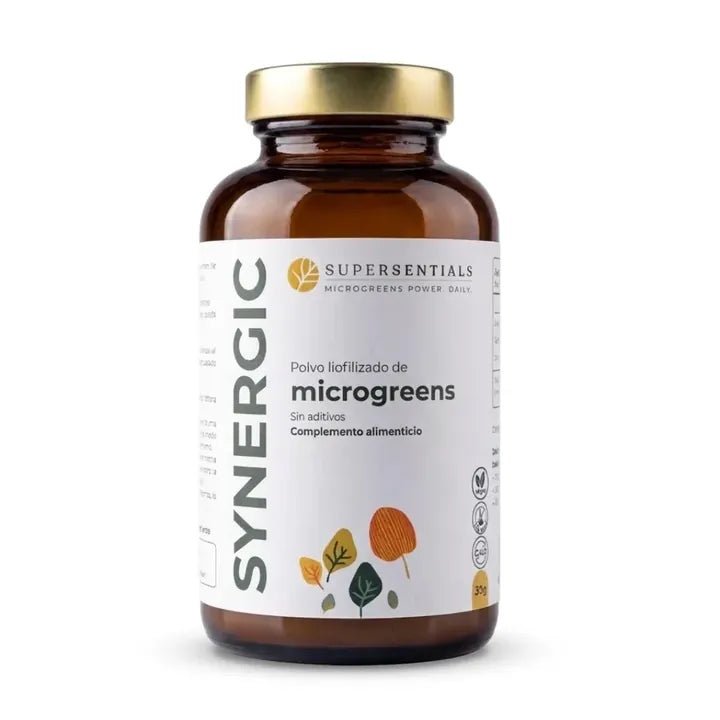
SYNERGIC
Whole-food Sulforaphane System™
Desde €49,60 con suscripción
Any questions?We have answers.
Can I get enough sulforaphane by eating broccoli?
Broccoli is a natural source of glucoraphanin, the main precursor of sulforaphane. However, the amount of sulforaphane we actually obtain can vary greatly depending on the variety, ripeness, preparation, and myrosinase activity.
To reach certain amounts used in research, large portions of conventional broccoli may be necessary, especially when conversion is limited.
Broccoli microgreens offer a much more concentrated alternative in glucoraphanin.
How does cooking affect sulforaphane formation?
Heat can inactivate myrosinase, the enzyme that converts glucoraphanin into sulforaphane.
Therefore, broccoli rich in glucoraphanin does not guarantee an equivalent amount of sulforaphane. Boiling it can significantly reduce its formation, while brief steaming usually preserves this process better.
Even if you eat broccoli regularly, it is difficult to know how much sulforaphane we are actually getting.
How much sulforaphane do we need per day?
There is no officially recommended daily amount of sulforaphane.
Clinical studies have used very different doses depending on the objective being investigated. For this reason, we cannot establish a single optimal amount for everyone.
The important thing is to distinguish between the amount of glucoraphanin present and the sulforaphane that is ultimately formed and remains available.
In addition, when trying to maintain a consumption habit, regularity and ease of preparation are important factors.
How much sulforaphane does one dose of SYNERGIC provide?
Each dose of SYNERGIC provides a minimum of 10 mg of sulforaphane formed in your glass, just before consumption.
What benefits of sulforaphane have been studied in humans?
Clinical research has explored sulforaphane in seven major areas:
- Protection against environmental pollution
- Concentration and cognitive function
- Glucose regulation
- Skin health
- Digestive health
- Immune response
- Healthy aging
How long do you need to take sulforaphane?
Clinical trials have studied sulforaphane over periods ranging from a few days to several weeks or months. There is no universally established duration.
To incorporate it into your regular diet, consistency is much easier when preparation is quick and the amount used is always the same.